EP 22 Buying the Big Fish: Ted and Sean LeLacheur on Risk, Legacy, and Four Generations
Listen to the podcast



Podcast Transcript
Speakers
Speaker 1: Matt Knight
Speaker 2: Sean LeLacheur
Speaker 3: Ted LeLacheur
Matt Knight 0:00
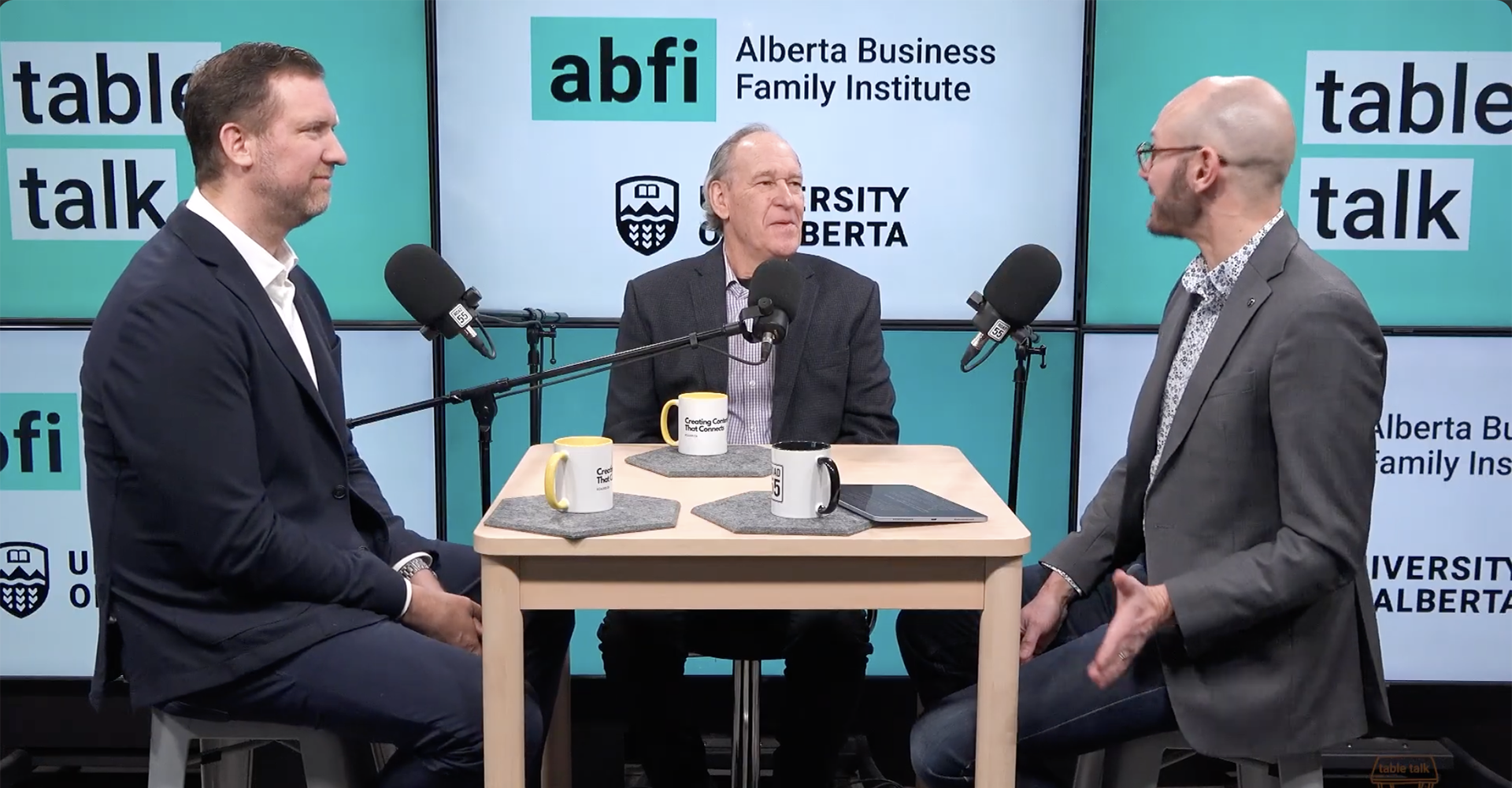
Welcome to Table Talk today. We have a rare conversation with a father and son sitting side by side, representing both the third and fourth generations of a family that's been moving Canadians across western Canada since 1906 they've sold the business a couple times. They've bought it back. They've rebuilt it from an empty warehouse, and the son's now led the business to acquire a competitor three times their size. For those of you who joined me at ABFI signature event in October, you heard the full or partial LeLacheur and Western moving story today. We're going to go a little bit deeper on strategy, the technology and where they see the moving and logistics industry is headed with both generations. Welcome to Table Talk the show, where business families share candid stories of growth, leadership and legacy. I'm Matt Knight, your host and executive director with the Alberta business Family Institute. Today, I'm joined by Ted and Sean LeLacheur of Western Moving and Storage and Matt co moving solutions. Ted has retired from the business as the president and was the third generation leader who knew from the age of 13 that he'd be in the moving business. He walked into a 10,000 square foot warehouse in 1995 and spent the next 20 years building it into one of Western Canada's leading moving operations, before transitioning to Sean, the LeLacheur family, as I mentioned, was our signature family in October, and I'm so thrilled to have Sean and Ted joining me today.
Ted, Sean, welcome.
Sean LeLacheur 1:35
Great to be here.
Ted LaLecheur 1:36
Thanks for having us.
Matt Knight 1:38
So Ted, for listeners who weren't at the signature event. And this is kind of a hard ask, but maybe give us a two minute version. Your family's been in the moving business since 1906 your brother Rick and you grew the business from, you know, to 25 locations and 400 employees. You sold it again in the 90s, and then you and Carol restart, started it over again. What made you want to do it all over again and walk into that 10,000 foot warehouse and have your oh shit moment that we talked about?
Ted LaLecheur 2:12
Well, to be clear in your opening comments, I'm the third generation, and Sean is the fourth. Yes, some sometimes people get confused that, you know, Sean is older than me, said no one ever in 1995 when we decided to regenerate the company, there was something missing in my life, and I don't know if It was the people or the pride that I always took or taken in the Moving and Storage business. But my wife Carol and I made the leap in 1995 to restart the company. I had been out of the business for about a year and a half, and people never, you know. People were still calling me saying, hey, Ted, I'm moving. You know, you know what's going on, kind of thing. So, so there was some of that, and there was some historical thought, you know, put into it. But it was an extremely nervous time, October the 17th, 1995 you know, when I did sign the lease and had absolutely nothing. The interesting thing was that ex employees were walking in the door saying, Ted, I hear you're back in business. Where do I sign my employment agreement? You know, which is pretty cool.
Matt Knight 3:42
Yeah, so just from that relationship and reputation that you had in the industry and with people that used to work with you,
Ted LaLecheur 3:50
Yeah, absolutely not. And that's, and that's pretty important, the moving business, I guess, is, like so many other businesses, it's a people business, yes, we use trucks, yes, we use forklifts, yes, we use warehouses, but it's a people business, and you know, so it was very important to me, and the business has been very, very good to Carol and I and our family. And I think that, I think we made, well, I know we made the right decision.
Matt Knight 4:20
Yeah, it sounds like that. That Oh shit, moment turned out pretty good. That's right. So Sean, you you didn't really plan on on joining the family business from the beginning, you kind of build some of your own ventures and kind of adjacent businesses as you're kind of starting out, what kind of changed your mind for other you know, maybe family business, next gen folks who are listening, who maybe feel that pressure of not knowing if they're going to join the business or not. How did you work through that?
Sean LeLacheur 4:50
It wasn't that I didn't want to join so I'd worked with Ted through high school. I'd worked in the summers and little bitty university I was I would drive. A for him. And it was, it was more I wanted to try something on my own. And, you know, Ted and my mom, Carol, were super supportive. You know, give it a shot. They said, Yeah, absolutely, go do your thing. And you know, the ventures that I'd tried on my own before coming back, you know, we're probably largely unsuccessful.
Ted LaLecheur 5:23
Financially. They were unsuccessful,
Sean LeLacheur 5:25
Very successful, learning.
Ted LaLecheur 5:27
Yeah.
Sean LeLacheur 5:27
You know. And I go back to when I was probably 18, you know, when I was coming back to work with the family business every summer. And when I was 18, they actually wouldn't hire me for that year. And that was the first time they said you got to go work for someone else and see what that's like, see what it's like not having the last name of the owner and and go see what that's like being an employee. So I did that, and then I did come back to the family business a bit before I started my own things. And ultimately, I tried a bunch of stuff and and I remember, you know, it was like a moment of, you know, moment of vulnerability, when I had done some things, and some worked out, but, you know, some didn't. And I said, you know, hey, I want to come back. And it was a genuine moment that I did want to come back, like I wanted to come back and join the business, you know. And they started me right back at the bottom of, the bottom of the totem pole, you know. And, but it was good. It was a really nice feeling coming back and joining it and kind of being where you belong.
Matt Knight 6:26
And Ted, what, kind of, what, what informed you to kind of make that decision for you, and Carol to say, Hey, Sean, why don't you go cut your own teeth someplace else first?
Ted LaLecheur 6:37
Well, I guess it's, I've always said that our company is not a perfect company, and it's important that Sean, in Shawn's case, you know, go work for somebody else. My brother Rick and I were in the business, and dad insisted that we go. Both Rick and I went to Toronto for a couple of weeks on different occasions, and worked with other movers, you know, see how they did things. Because, you know, maybe they were doing something different than than we were doing and and that was a real education, certainly for me, and I know, and I know for Rick, and we're very big on on I'm not sure if the word is mentoring, but, but I think it's really important.
I just learned last week… I'm a Rotarian. I've been a Rotarian for 49 years. A fellow from India reached out to me. His son is going to the U of A and then we'll be going back to India to work in the logistics business. And he reached out and said, Would you, would you meet with my son, and, you know, show him your place and everything, and I'm just on cloud nine. How did he find you? Like, through the rotary Rotary International. He just, he just sent an email and said, I don't know if you're interested, but I see your name in the rotary roster and it just blew me away. And so, so we have a meeting scheduled for next week, and I'm looking forward to it.
And I think that's really important to mention that both Carol and I have been very gung ho on helping people, teaching people that it's not unusual for another mover in town to call us and say, Hey, we got a problem. You know, can you or Carol help us out, and if it had to do with admin or paperwork, which I don't, I don't particularly care for. That was Carol's job. If it was sales or operations, that was my job and and, you know, I treat them, treat the competitors with respect. They're there. They work just, just to make a living, same as we do,
Matt Knight 9:00
And they never know when, when you're going to need help. Either. They're always like building those relationships.
Ted LaLecheur 9:00
100% Matt, 100%.
Sean LeLacheur 9:00
I always thought I just wasn't a very good employee. Is that why you didn't want to bring me back?
Ted LaLecheur 9:12
No, it was to be working for your mom and dad. Is is, is is a different, different kettle of fish. I work for both my dad and my brother, and I actually had one of our employees about three months ago say, Well, Ted, I'm a little confused. When does Sean ever call you dad? He always calls you Ted. I said, Well, that's the way it happens when we go to Sean and Melissa’s house for supper, it's dad when it's at the office, or it's Ted and Carol. And I have never had a problem with that.
Matt Knight 9:53
Yeah.
Sean LeLacheur 9:54
I couldn't imagine being on the job site as a young kid being like, Hey, Dad, you. Yeah, you know, in the in the transport world and eaten alive
Matt Knight 10:04
It would have been hard enough. Yeah, you know, with the with the last name, let alone how you interact,
Sean LeLacheur 10:10
I used to try and fly under the radar a little bit. And, you know, the people that knew it was fine, but you know, I would always try and fly under the radar Ted Carroll and just try and work harder than everyone else, because you knew they were going to find out. So…
Matt Knight 10:22
Yeah, there's a different podcast. The other night. There's a one of the Samsung children. She, you know very, very close family, and she went, she ended up going to work for the company, and didn't tell anyone who she was. So it was almost like undercover boss,
Sean LeLacheur 10:40
Undercover Boss.
Matt Knight 10:41
But it wasn't, it was, it wasn't set up that way. She just didn't want any of that reputation. And then once someone actually figured it out, you know, she had already worked her way up, so it's pretty interesting way to do it. And then it got a little bit more interesting because then she married her bodyguard, and that created a lot of drama.
Ted LaLecheur 10:57
Oh yeah, the problem with Sean is he's, he's always hung out at the office. And, you know, since he was a little guy, and now he's, he's taken his little guy to the office. And it's just second nature. If you go into work on a Saturday, you take one of the kids, and I can remember Sean fooling around in the warehouse. And, you know,
Matt Knight 11:19
Warehouses are a lot of fun.
Sean LeLacheur 11:21
Yeah, it's a big field trip in my house, take my son to the warehouse, and it's a big day.
Matt Knight 11:28
So we'll shift gears a little bit and talk a little bit more about kind of the moves that shaped where you are today. We talked a little bit about it in October as well, but Ted, let's maybe talk about the switch back in 2008 from Allied van line to United Van Lines. Pretty big pivot that we heard about. Then maybe walk us through that decision, what it meant for the company, and kind of what that means for listeners who might not know what a van line setup kind of is
Ted LaLecheur 11:59
Sure we were what's called an agent of allied Van Lines. And every van line is very similar in that they take a piece of the action because of the services they provide. And my dad was actually at the founding meeting of Allied Van Lines in 1948 so allied band lines meant an awful lot to us. Carol and I, we re-established in 95 and 2007 was an exceptionally tough year for us working with Allied Van Lines. And again, I don't want to say anything derogatory about them, but, but Carol and I wrestled about, you know, with the decision. For a number of years, United Van Lines had always been chasing us, you know, to convert. And finally, I just phoned the president of United Van Lines and said, we're ready to talk. And she said, Well, I thought your underwear was always orange, which is the Allied Van Lines color, right? And so, you know, one thing led to another, and we, we converted very successfully, very, very happy with where we are allied. Van Lines is still doing very well, you know. So, so life goes on.
So the interesting thing I thought about the conversion was that Carol and I spent about once we made the decision sign on the dotted line in Toronto, we came home and, well, we got to have a meeting with the employees, right? So her and I spent an inordinate amount of time writing a speech for me. But I was going to say because I've been known to ramble on.
Sean LeLacheur 13:41
No.
Ted LaLecheur 13:41
Yeah. And so we, we prepared a speech, brought in all the employees and into the into the lunchroom, and we, they were all sitting there, and some of them knew something was up. There was no secret that something was up. And so I went through my whole spiel about we've converted to United Van Lines and and after the presentation, one of our senior guys, a driver, came up to me and goes, Well, Ted, let me get this straight. I'm still moving boxes and furniture, right? And I went, Yes. And he goes, Okay, see ya. You know, it's, some people hate the same, but it's, it's the same circus, different clowns, right? The United Van Lines and Allied Van Lines are in exactly the same, same business. And we had just Carol, and I had, I would say, agonized over converting, but in 2008 when we did sign on the dollar line, it was a huge, huge decision, and and we haven't looked back.
We're very you know, one of the things for Carol with United Van Lines is United Van Lines is a Canadian. Company, and she's always been big on that. And the board of directors of United Van Lines knows where Moose Jaw is, right. The fact of the matter, Allied Van Lines, as Head Office, is in the States. And if you called them, I don't think they'd know where Moose Jaw is.
Matt Knight 15:19
Yeah and Sean, that relationship is kind of carried through today. I think you're on the board of United Van Lines. Now, what does kind of that partnership and support with them mean in this next generation of the business?
Sean LeLacheur 15:32
Yeah, it's, it's been great. You know, I've sat on the board of directors. Now, I believe I'm coming into year five or six, so I'll be the incoming chairman in probably four years. I'll be the chairman of the board, and so I spend quite a bit of time, you know, working on that with them. And I'm fortunate to be surrounded, like he says, with a bunch of really great people that understand the business and have a really good geographical representation of Canada, which is really nice, you know, the the whole model behind United Van Lines is very different behind the scenes than Allied Van Lines is, you know, in Canada, it's, it's agent owned, you know, and so everyone kind of owns a piece of the action, and is just that much more vested in in the success. So, yeah, we, we've enjoyed that quite a bit. They support, you know, what we do out here and what I work on, you know, and with our businesses, they support us quite significantly. And I hope that, you know, the other agents within United feel the same way, right?
Matt Knight 16:31 And then the other kind of big pivot that we talked about a little bit was the Matco acquisition, or partnership a couple years ago, where, you know, you described it as, as, you know, the little fish eating the big fish. Going from, you know, a handful, a couple dozen employees, up to 200 overnight walk us through kind of the strategy behind that.
Ted LaLecheur 16:53
Ohhh Ohhh ohh can I begin?
Matt Knight 16:55
Sure.
Ted LaLecheur 16:55
Yeah, I don't know what the word is. It wasn't pivot. I remember vividly in Sean's office, and we were having a meeting with our advisory council, and he announced that he wants to buy Matco and I really can't say what I said, but suffice to say, my first reaction was absolutely not little fish, buying the big fish. But once he presented the business plan, made absolute sense to
Matt Knight 17:30
And was that your reaction? Purely because they were, they were larger, like, what created that?
Ted LaLecheur 17:39
Oh, that's a good question, Matt, I think it was because of my age. You know, I wasn't prepared to sign another personal guarantee at my age. I wasn't prepared to, you know, go into Hawk, you know, at the time, but and the sheer size of it, I mean, we'd known the Matco moving solutions company for a long, long time. They're a good company. They were well run. And it was, to be quite honest, I think the the thought of purchasing the big fish, as you call it, was scary for me at my at my age, not for his age, but for my age, and so after he presented the whole the full meal deal, and so on and so forth, and we did a lot of work on it, you know, kind of behind the scenes like it made it made sense to me.
Sean LeLacheur 18:37
I believe your exact answer was…
Ted LaLecheur 18:39
Yes, that was the exact answer. But you can't say that you're on a podcast. You can't say that.
Sean LeLachuer 18:45
We could post edit that?
Matt Knight 18:47
Like one of those beeping machines. I'm sure we have, I'm sure there's that technology.
Sean LeLachuer 18:50
And you know what I've learned? You know, Ted and I are wired very different, and you know, and I learned a lot from him over the years, and I still learn a lot from him. I'm lucky to have him as a mentor. And he is an emotional brain, and I am a logical brain, and I have a lot of blind windows, and one of his is when you present change, you get an instant reaction. So I'll never forget I got the response. And I said, Okay, I don't need the answer right now. Just think about it, you know, over the course of a week, I'd, you know, present more info about why and what the logic was and and eventually, you know, you came right around to it and saw the same thing I did. I think it was just that initial shock value that he never expected when you walked in that day.
Ted LaLecheur 19:40
100%, you know,
Matt Knight 19:41
But, and we'll go back to the matt co thing in a second. But how do you know you had that reaction to Matt co but yet, you know, the level of risk and entrepreneurial, you know, vision that you had when you restarted Western moving was probably that, you know, a very similar level of risk.
Ted LaLecheur 20:01
A big difference in dollars, though, but, but you're absolutely right. You know, there's huge risk. There's huge risks when we, when we acquired Matco but I have faith in him. I have faith in Sean and the leadership team that he, that he's now, now has with the matco group, and very, very proud and pleased with certainly, the direction he's taken the company. There's no way I would have taken the company to the same degree that he's taken it. You know, we have three or four software programs now, of which three or four software programs Sean doesn't give me access to,
Sean LeLachuer 20:48
Or you have it, but you forget your password,
Ted LaLecheur 20:50
But I forget my password. So he's taken the company to excluding the matt co thing, but he's taken the company to another level. And that's a generational difference, right?
Matt Knight 21:04
But is it like, like, if you look at how, like, where you, you and Rick built the business back in the 90s, like, you probably went through some big or you went through some big acquisitions then,
Ted LaLecheur 21:15
Yeah, well, but again, Matt, like, I had faith and Rick and he was the Boss Hog of the day. And I was, I was a salesman. I was doing quite well. I enjoyed selling. Got involved with operations, but, but, you know, I just kind of, kind of followed him along the acquisition path, if you like, well.
Matt Knight 21:43
And part of, part of me getting Ted wrapped around it was bringing Rick into the fold, you know, and I presented the same thing to Rick, and then Rick understood, and then Rick joined Ted and Carol and I to present the opportunity. And I think there's a degree of comfort there, yeah, just with Rick, right? That if, you know, if Rick was good with it and understood it, that, you know, Ted could wrap his head around it and, okay.
Yeah. And, and was, is that kind of, you know, Rick is also on your board advisors, is that kind of, you know, some of the acquisitions and growth that he went through, like, is there some some parallels there that you're looking to, to learn from,
Sean LeLacheur 22:20
Yeah, it's, you know, the history of the family business. When Rick and Ted were there, you know, they started with an office. And basically, was Edmonton, Yellowknife, was it Edmonton or Fort McMurray?
Ted LaLecheur 22:30
Well, it started out in Edmonton, and then Grand Prairie.
Sean LeLacheur 22:33
Grand Prairie.
Ted LaLecheur 22:34
And then Fort McMurray, no. Grand Prairie, then Yellowknife.
Sean LeLacheur 22:40
Yeah. And basically, Rick had a business model then, of acquiring businesses and was quite aggressive and spread across the country before, before him and Ted and the business decided to sell in the early 90s. So you know what's nice with having Rick as an advisor? So he does. He chairs our advisory board, and Ted and Carol both sit on that board as well.
Matt Knight 23:07
Then do you have external people on there as well, or is it just the four of you.
Sean LeLacheur 23:09
You know, we've started with just the family. So we have and our CFO, yeah, and our CFO, you know? And we have plans to add external but it was a new process for us when we started it, and right now we got a really good rhythm, you know, and I'm lucky to have someone like Rick as a mentor as well, who's lived kind of the the current iteration that we're in about, you know, we have a vision of what we want to be and where we want to go to get there, and and he's kind of walked that path before, and has a lot of really good insight as to as to How to go about it and see it's very valuable, you know. And he's involved in all the discussions for potential acquisitions. And even when we sold our records management business, he was involved in that from day zero.
Matt Knight 23:53
And then, you know, so Matco was also a family business. I believe it was the Anderson family, back in the day they had, you know, there's a transition in between the two. But how did that kind of play into it? And do you find kind of opportunities for, you know, the culture that they have within the organization to fit really well with Western you know, has that helped at all? Or did that play into the strategy?
Sean LeLacheur 24:15
Yeah, so it's actually Matco’s 60th anniversary this year. So they were founded in 1966 with the Anderson family. And yeah, like you said, there was a family run business for a long time. They sold in the 2012 2013 area, something like that, to Manitoulin Transport, which is a privately held company out of Ontario, but a very large privately held company. So there's just a little bit of loss of culture from a family, small family run business, to large business. So when we came in and acquired Matco from Manitoulin, I think there was a little bit of going back to the grassroots, going back to, you know, family operated local presence, you know, with. Within the territories and within Alberta and so I think it's been really nice - you have a lot of long term staff that have been there from when the Andersons ran it. So I think it was, to some degree, a nice, nice moment to be able to come back to that grassroots family business.
Matt Knight 25:16
This episode of Table Talk is proudly supported by QV Investors. QV is an independent, employee owned asset and wealth management firm with nearly 30 years of experience helping high net worth families and Canadian institutions grow their capital. If you're a family business leader thinking about your wealth, reach out to qv and have a conversation. Learn more at qvinvestors.com
Matt Knight 25:37
Shift gears a little bit to kind of technology, and what you both see is kind of the future of the industry. So Ted, you know, kind of when you started in the industry, when you, you know, we're, you know, restarting it with Carol. What did running the business look like from a technology perspective? What were some of the big changes you remember having to go through?
Ted LaLecheur 26:02
Well, yeah, I can remember typewriters, you know. And I can also remember we typed all of our Bill of ladings as an example. And one, one particular day the computers had crashed, we had to type a bill of lading. And Carol being the girl that she is, we we had a portable typewriter in the office, and so we pulled it out, and he was a young fellow, and he kept looking around and going, what are you doing? He goes, Well, I'm trying to figure out how to turn it on, right? So technology, of what you know Sean is what I call my IT department. And, you know, he's brought in a number of platforms to enhance everybody, right, you know, right, from sales to ops to administration to, you know, and, and I, I concur 100% because that's, that was the that was my weakness, or that is my weakness is, I'm one of those guys who's technologically challenged.
Sean LeLacheur 27:13
That's your vintage, you know. Like, that's not uncommon, right?
Ted LaLecheur 27:17
Yeah, no, no, yeah.
Matt Knight 27:19
And it's - but it's also different. And I was gonna get into the rate of change in a second, but a second, but like So Sean, so like most people, when we think about moving, you know, they'll think, you know, trucks and boxes. But really, you know, what does the actual operations look like from kind of the modern, you know, tech stack perspective? What do you think would surprise most people when you when you, when you kind of bring that, if you brought them inside the workings.
Sean LeLacheur 27:43
Yeah, you know, like, our business is complex with, you know, we move, we're, we're movers. But, you know, we do local moving, which is fairly basic, straightforward, very labor heavy from, from that side, but we do a lot of long distance moving, international, moving, us, hauling moving, when you get into those longer distance, higher complication, you know, even when we haul to the far north, like Inuvik and Norman Wells, which is ice roads this time of year, it's a lot of planning. So a lot of the operations team spend a lot of time trying to optimize planning, to make sure that, you know, we maximize the amount of product that we can get on trucks while adhering to the delivery promises that we've made.
You know, everyone that we work with and we move, we tell them they're going to get their product in a certain time window. So it's important to balance that in so the amount of technology we use on, you know, for routing and timelines, and within the current compliance world, you know, times have changed a lot now with compliance in transportation versus when, when Ted was running the business, you know, thee logs now and the compliance side, there's nowhere to hide. You know, there's computer modules that are attached to the trucks that limit exactly how much you can drive in a day, and all these things. So there's a lot of planning that has to go in to make sure that you can do it.
Matt Knight 29:04
And then so there's, what about kind of AI and artificial technology in the business? You know? How? You know, how are you using it today? Or how are you thinking about it today? What do you think are maybe some of the big opportunities?
Sean LeLacheur 29:17
You know, like we're there's a lot of ways we're thinking of using it. The one way that we are using it now that's changed significantly is, you know, we used to be an industry that was heavy in person surveys. So if you're moving, we'd come to your home, take a look at what you're what you're moving. You know, the folks would have tablets, and they would do all that in the home.
When covid happened, that kind of abruptly came to a stop. So we did a lot virtually, and what that spawned with the combination of AI is virtual tools that are AI driven. So rather than a sales rep having to record a virtual survey and go through that recording and pick out all the items that you're shipping and come up with the estimated weight, there's AI tools that we use now that will compile that. For you at least, to a first pass with, you know, typically 85-90% accuracy. So it, it cuts down the time required quite a bit. And even from a client perspective, they like, they like seeing it because it's well presented and much faster. So it allows us to get our quotes out a lot faster.
You know, future, there's going to be a lot, you know, we see it now in the analytics, you know, especially with compliance, there's a lot of AI tools that are analyzing our data, to analyze the trends, to analyze, you know, vulnerabilities or things that you need to improve. So there's a lot coming, I think, with any business right now, it's, it's every vendor we work with seems to have some form of a beta AI or something that they've already integrated. And I expect that to continue,
Matt Knight 30:46
Yep, and it's now like validating to what level that actually is there, and if it's how it's going to help the business. So Ted, you've talked a couple of times about how, you know, at the end of the day, it's a people business. When Sean starts to talk about some of these, you know, AI and the you know, imaging going through someone's house and helping to create the packing lists and things like that. What, what kind of questions or what kind of thinking do you have to kind of make sure the human side doesn't get lost?
Ted LaLecheur 31:14
Well, it scares the hell out of me, because I am that my son so adequately put vintage AI. You know, scares me personally, but in talking to a lot of our employees, I can see, you know, the the real benefits of it and and I know he's, he's Sean has looked at it and is open to it, but again, it's, I think it's because of his age and my age. I think that AI, it's kind of like when the internet came in, everybody was afraid of the internet. And now, even being retired, I can't be without it, right? You know? So I think that's the vein that older people have to take. The same can be said about internet. There's some great stuff, but there's some awful stuff. And I think the big fear with with older people is, I don't know what the word is, fake news or like, you know, if you see something on your tablet today, you don't know if it's legit or or phony or, you know, whatever. So I think you got to be very, very careful with it.
Sean LeLacheur 32:35
We've just spent a lot of time, you know, our leadership team is good to have a mix of youth and wisdom. And the way we approach all the new technology and the coming AI changes is by putting a lot of time into change management and communication around that we have a very broad set of employees when it comes to their their age, vintage, like we have some people in their 20s, and we have some folks in their late 60s, early 70s.
There's a big gap in technological ability there. So how we communicate it, how we support it, and manage it, because it's going to come one way or another. So we're always talking about how to, how to manage this change when it does come, or when it, you know, finally lands on our plate and and yet, it's a lot easier with with the younger folks, because it's so much more second nature to the younger, even folks younger than me, that it's, it's, they pick it up so quick, and it's just intuitive.
Matt Knight 33:31
Yeah, and the research that we're seeing and some of the work that we're doing with, you know, even talking to the students in my classrooms, is like, there's that gap that you need to close between, You know, the openness to technology and then the knowledge and kind of the institutional and industry wisdom. So we're seeing a lot of like opportunities for almost like reverse mentoring and mentoring of, you know, you help me with the industry, I'll help you with the technology. Let's go through and see how we can build this together. So, you know, one of the things that kind of brings us to is, I think one of the large challenges we're seeing in Alberta and across western Canada is around labor, especially in skilled trades and places where you're where you need to get good people in to help. Do you see technology as part of the answer to that, or do you see it as creating another, you know, additional problem to be managed?
Sean LeLacheur 34:25
You know, the way we look at it might be different than certain trades. You know, we're not a ticketed trade. We're more of an unofficial trade. That's how we look at it. So when it comes to recruitment and employment, as of late, we've actually had really good success. When you roll back to, you know, the booming oil times of the past, we would really struggle. And Ted used to always lovingly call it the Alberta disadvantage is being a, you know, a general labor employer or a non ticketed trade in Alberta was actually, at times, felt like a disadvantage, you know. So we would be losing people. To, you know, areas like Grand Prairie, Fort, McMurray on a regular basis. It's a little bit different now. And I think, as you know, with the advancement of AI, it's going to change a lot of industries before ours first, you know, we are still a, you know, we are moving atoms. We're moving things around from A to B, you know. And that's something we take great pride in, that we're hopeful that, you know, there will be more opportunities to work with people that you know may have seen their industries change sooner, where it maybe cuts back on some of the opportunities there, and that we can hopefully provide some opportunity.
Matt Knight 35:34
So kind of where we're headed, and let's, you know, not think of like standard logic or anything right now, so thinking 10 years out, you know, with the rate of change we've seen over the last couple months, even in AI, so say, 10 years from now, we're, you know, autonomous trucks. You know, little robot dolly jacks that help move things around. Ai, logistics, virtual estimates, full thing, what's, what's real? What do you think you're actually going to see, and what's hyper or fake news? As Ted was talking, talking about, well,
Sean LeLacheur 36:05
I personally think you're right. You will see some form of autonomous truck within domestic Canada. You know, there's a lot of challenges in northern Canada and extreme climates that I'm not sure how long it'll take to get autonomous there, or if it ever does. You know, there's such a lack of infrastructure. You know, we're on our way to Norman wells today with two full loads. You know, these are ice roads. So these are non permanent roads, so those become more challenging in that environment, but I'm sure they'll figure them out at some point.
Matt Knight 36:32
Has a Tesla bid on the ice roads yet?
Sean LeLacheur 36:35
I doubt it. Well, you never know
Ted LaLecheur 36:38
Tesla was up to the Arctic Circle.
Sean LeLacheur 36:39
Yeah. So, you know, there's a lot of I think that's an inevitability. I think it's driven specifically in areas like the United States and Europe where they don't have the harsh weather climates they can test year round. And get that figured out. So it'll come. You know, there's no doubt that'll come. I also believe that the, you know, the technology with robots and robotics is going to come real fast too. You know, you see those videos of some of the things that these robots can accomplish now, I'm sure that'll come.
And you know what that looks like in our world is, I don't know, you know, we'll, we'll probably be open to it when, when the time comes, but it's, you know, we're such a hands on, you know, maybe in a warehouse setting is the easiest application in the shorter term. You know, it's a little bit more of a controlled environment. When we get into clients' homes or clients' place of business, it's a little bit of a challenging environment that until I see proof of concept with what the capabilities are, but really, like you could imagine pretty much endless possibilities.
Matt Knight 37:43
Yeah, do you have any robots today?
Sean LeLacheur 37:45
No, no, we don't. You know. We, we've, we've looked at some automation for our warehouses. And, you know, when we first looked at it, it's a little bit cost prohibitive, it, it's meant for some you know, the big Amazon style warehouses, and in our world is still a little bit niche. We're not just moving just widgets and gadgets. There's a lot of variability to what we handle. Yeah, so those sort of old, I would call it the old world, autonomous just doesn't work. But you get, you know, AI autonomous, where it can be intelligent, then, then you have possibility.
Matt Knight 38:18
And Ted, I mentioned this earlier that I was going to talk about it. So you know the change that you've seen throughout your career, does it feel any different right now? Like, like, is this faster change? Like, what would you tell your 1995 self about where the world is going? And I know those are a lot of questions.
Ted LaLecheur 38:35
Well, I grew up in an era with Dick Tracy on TV and using a phone his watch is a phone. You can do that. And you know you can, you can do that. My wife does that. I want nothing to do with it, but my wife doesn't. Okay, and that's fine. I think one of the changes is the general environment that we're in, between employees and customers. I think today, customers are way more educated than they were, you know, 5-10, years ago, because they're on the net. They're, you know, doing their, as my wife calls it, the 411, information gathering and and has a lot of questions, probably more questions today than they had, you know, 10 years ago, because they've got this basic information, like people say about buying a car. Well, well nowadays they do so much of you know, the investigation online, they just walk into a dealership and say, That's the car I want, you know.
Matt Knight 39:44
So do you think so? You think consumers are much more informed today?
Ted LaLecheur 39:49
I do. I think that they're I think they're smarter and and I think the industry is smarter too. I think the industry has done a remarkable job of our industry - the moving, the storage industry to to keep up with the times, as Sean's indicated with the with the virtual surveys, you know, number of years ago, if, if we had a prospect call us in from white court and say, I'm moving white court to Calgary, well, it's 110 miles to Whitecourt. So, you know, the salesman would drive up to white court, you know, spend an hour, hour and a half with the customer. You know, drive back, and that's half a day for one survey. So, you know, I really see the advantage of things like that. You know, the software programs that he's got our folks involved with is a little bit, well, a lot above my, you know, pay scale.
Matt Knight 40:51
So Sean thoughts on a similar question, like, what do you think about the rate of change today versus some of the other things you've seen in your career?
Sean LeLacheur 41:01
The biggest thing now I see is it's the rate of the rhetoric. There's a lot of talk of what it's going to look like in the future and I think that's what gets everyone's mind racing. I think the current day, you know, tools like, you know, open AI, and those, they're great tools. You know, some of the rhetoric we hear about what's coming with autonomous vehicles and robotics. It makes your mind wander. For sure, I'll be curious to see what the adoption is, and when it actually goes, goes to actually the workplace, you know, like outside of, I would say, the extreme rhetoric of what the future might look like. I don't think the rate of change has been unmanageable in the short term. You know, if some of that rhetoric comes true, you know, that's a different, a different speed of change, for sure, that'd be a big level change.
Matt Knight 41:50
Shift gears a little bit before we wrap up, do a little bit of what we call our lightning round. So this is gonna be difficult. I'm gonna do like, four to five questions, but I want very, very short answers.
Ted LaLecheur 42:02
Why do you look at me when you want short answers?
Sean LeLacheur 42:04
Everybody looked at you.
Matt Knight 42:06
You had a disclaimer at the beginning. You said you said it yourself. So I'm just playing into that. So quick, quick questions. So first for both of you, maybe we'll start with you,
Matt Knight 42:15
Ted, hardest part about working with family.
Ted LaLecheur 42:21
Working very hard after hours not to discuss business.
Matt Knight 42:28
Sean, same question.
Sean LeLacheur 42:29
Yeah, leakage into your personal life. We work really hard not to talk about business. But, you know, it's impossible, right? It comes up and, and that's okay, it's, it's in our fabric.
Matt Knight 42:39
Yep, I'll start with you again, Ted, because then you can help set the stage a little bit. But best business advice from the generation before you?
Ted LaLecheur 42:52
Look after your people, your employees, because they will look after your customers, and if you treat your employees right and pay them, you know what's right, look after them, guaranteed they'll look after your customers.
Sean LeLacheur 43:10
For me, I would say, if it was easy, everyone would do it.
Matt Knight 43:15 We'll start with you this time. Sean, weirdest thing your team or you have had to move.
Sean LeLacheur 43:21
Oh, man, we've moved some interesting stuff. You know, I would say the weirdest one was a mummy, like an Egyptian mummy that was here for a showcase. I don't know if you remember that.
Matt Knight 43:34
Okay, so not like someone's personal mummy.
Sean LeLacheur 43:42
No, no.
Matt Knight 43:42
Like it was like a museum type,
Sean LeLacheur 43:42
Yeah.
Matt Knight 43:42
Yeah. Okay, not someone, not someone, not just some, like private mummy collector.
Sean LeLacheur 43:43
No, no, okay. They may exist, you know.
Matt Knight 43:45
Yeah, Ted thoughts, we're just weirdest thing.
Ted LaLecheur 43:48
Yeah, I can't recall the mummy story, but…
Sean LeLacheur 43:51
I'll never forget…
Ted LaLecheur 43:52
But that's a good one. I think the weirdest thing move I got involved with there was a gal moving to Vancouver, Island. I went to see her. Well, when on the phone, she says, Now I have to warn you, I have some stuffed animals. That's okay. Well, you know, fur ball. So I get to the house, and I walk in the house, and as soon as I walk in, there's a seven foot fabric giraffe that used to be at the Bay. And she's and I said, Oh, is that your stuffed animal collection? And she goes, Oh, no, no, Ted, we walked through the house, plus or minus she had 21,000 stuffed animals. And to me, that was a bit unusual, but she was a great gal. And you know,
Matt Knight 44:39
That's where you charge by volume, not weight, right?
Ted LaLecheur 44:42
No, unfortunately, she was moving to the island, so it was by weight. So yeah, good point, Matt.
Sean LeLacheur 44:47
I remember we moved the Magna Carta once. Remember that?
Ted LaLecheur 44:51
Yes, yeah, yeah.
Sean LeLachuer 44:52 We've done some interesting stuff over the years.
Ted LaLecheur 44:55
Yeah, we've, we moved the Edmonton police exhibit, exhibits from their downtown to another location and secret location, and we, we were going to have a truckload of guns. And so when we met with the police, and I said, Look, I said, we're, we're registered with the federal government for moving of guns, gun, not a truckload of guns. And they said, Don't worry, Ted, it's all looked after. I had a concern about the amount of guns in the truck. They had a concern that the truck might be hijacked, so they assigned SWAT front and back, and me further back, following the truck. And the SWAT team, they actually had SWAT follow the truck right to the destination to unload.
So, you know, it's things like that, you know, we have one on the go now. Good friend of mine is with the Hockey Hall of Fame, and they're talking about a tour. And this is the Jack Adams trophy and the Con Smyth trophy and things of that nature. And it's just, it's remarkable that the type of businesses that that we do work for, and it's not just household goods, you know, residents. It's not just office furnishings, you know, we, we do an inordinate amount of hotel business, which is kind of cool, because you can, you can really see, you know, going into a refurbished hotel, you go in and it's bare walls, and then when we leave, everything is there.
Matt Knight 46:40
Yeah, Sean and I were talking about that the other week. And it's fascinating to think about that side of moving, of getting everything moved through a hotel, and getting all the furniture and because they always had that built in stuff, so getting that all replaced.
Ted LaLecheur 46:55 and, you know, attach the pictures to the wall, and, you know, you know, blah, blah.
Matt Knight 47:01
So that leads me to a similar question, what do you think? What's the hardest move you've ever had to make? And for you,
Ted LaLecheur 47:10
The moves I never did, like was the, what I would call the high profile moves. When we moved Premier Lougheed down to Calgary, we kept it very quiet, you know, but it somehow had, had got out, and the next thing you know, we know those television cameras and the journal is down there and and things I was Just too much of a perfectionist. I sweated bullets, you know, with the high profile moves, just in the event of.
Matt Knight 47:48
So, not your retirement.
Ted LaLecheur 47:51
Not my retirement, except this Hockey Hall of Fame tour I'm in charge of so…
Matt Knight 47:56
Sean, thoughts?
Sean LeLacheur 47:57
You know, I can think of one, and it was a, it was a professional athlete here, out of Edmonton, moving to the US, and I remember just the vast amount of stuff that was all unique, like challenging, big, awkward, expensive, and We sent almost three tractor trailers from this home down to the US. And had to, you know, make sure we had the right people to do it and even to catch it down in the US. And, you know, like you said, they're high profile and challenging, you know, very, very challenging to make sure that you handle that stuff with due care and attention.
Matt Knight 48:38
Yeah. And then another question for both of you. So if western movies didn't exist or never existed, what do you think you'd be doing?
Ted LaLecheur 48:49
Oh, I don't know how I'd answer that, Matt. I mean, you know, I started the rule in our house was when we turned 13, we went to work at the company in the summer and the holidays and, you know, I'm well retired. Now, I wouldn't say vintage, but well retired, and so I started in the business when I was 13 years old. No doubt I'd be a salesman, because I like to talk, you know, but that's a difficult one for me to answer.
Matt Knight 49:23
Sean?
Sean LaLecheur 49:23
You know, you initially said you'd wanted to be a Walmart greeter when you retired, because you get to just talk to people.
Ted LaLecheur 49:28
That's right. So, you know, so if Walmart listens to this podcast, I'm available. You're open.
Matt Knight 49:33
Yeah, if the Walton family is listening.
Sean LaLecheur 49:35
Just provide a chair.
Matt Knight 49:37
Yeah, there won't be a greeter role in the new Atchison warehouse.
Sean LaLecheur 49:42
Unlikely, yeah, unlikely, yeah. You know me. I would definitely do something with like, the thing I like, what I would do is talking to a bunch of people. So it would be anything to do where I could have good variety, talk to a bunch of folks, ask questions. That's what I get energy from is just talking to people. So anything that could do that, I could be a Walmart greeter, I could be a salesperson, I could be a customer support agent, anything like that.
Matt Knight 50:11
So maybe I'll ask this question, and you can go either direction, actually, but first I'll ask my one question I try to ask on every podcast, one book that you would recommend to people the most, or do recommend the most and why?
Sean LaLecheur 50:27
Well, I'm not a huge reader. My wife has got me reading, and I'm James Patterson, you know, very easy to read, words that I can understand and I enjoy it. I just recently finished the Mark Critch book, you know, from CBC, and I really enjoyed that
Matt Knight 50:51
Any kind of, like thinking back to, like, business book or leadership book.
Ted LaLecheur 50:55
No, hell no,
Matt Knight 50:57
Not your style?
Ted LaLecheur 50:57
Not my style.
Matt Knight 50:58
Okay, Sean?
Sean LaLecheur 51:01
You know, one that I really liked. And maybe it's because, you know, he's been through town here was awesomely simple, which I was John Spence, yep. And, you know, I quite enjoyed that. That was probably one of the first, like, business books that I'd read. And, you know, recently, I've been reading a lot of books around, you know, like Navy SEAL mindset and just, you know, what it takes to be, to be gritty and stuff like that. So, yeah, those are cool.
Matt Knight 51:25
So this question you can answer either way, either, you know, future focused or past focused. But what? But what kind of do you, you know, feel should be the lawless or Western families you know, kind of, you know, biggest accomplishment or legacy that you want to leave, or accomplish that you made, like, what do you think's the defining thing on either side? Kind of an awkward question.
Ted LaLecheur 51:48 Well, no, I think I understand where you're coming from. I again, I go back to the employees you know, up until you have you can find a robot to pick up that fridge in the basement and take it to the truck. You're always going to have humans doing it. And I think that looking after the employees, to me, is paramount. I want people to be proud of where they're working, proud of what they do, because it is, as Sean has indicated, it's an un ticketed profession, but you see a van Foreman out there loading and loading one of our trucks for Ottawa. And these guys are professional guys and girls. We have a number, a number of gals that are working for us now in warehouse positions and packing positions, and so…
Matt Knight 52:44
Nice, Sean?
Sean LaLecheur 52:47
You know, I think it would maybe center around opportunity. You know, I agree with what Ted said 100% like our people are everything in our world. And I would want people to think that when they worked with us, there was opportunity, you know, an opportunity to get a start, and an opportunity to prove worth, and an opportunity to kind of go along, go along for the ride, and, you know, get a glimpse into the crazy head of the LeLacheur family and see what we we put together awesome
Matt Knight 53:15
Well, Ted Sean, thank you both very much for being here with me today. What strikes me most is really kind of that generational thread story. So everything from, you know, Ted you walking into the warehouse wanting to restart it for the people, to you know, Sean you walking in and wanting to, you know, kind of grow and continue that, that entrepreneurial legacy that the three generations prior had kind of built. So I see a lot of kind of connection and camaraderie. You know, even though you both define risk differently, but I think in that, in that ability to take opportunity and turn it into something real.
Sean LaLecheur 53:50
Thanks.
Ted LaLecheur 53:50
Thanks for having us.
Sean LaLecheur 53:51
Yeah, this is great. Thanks Matt.
Matt Knight 54:02
Ted and Sean, thank you both so much for being here with me today. What strikes me most about the generational thread is the opportunity and and risk that you seek out both Ted walking into an empty warehouse in 1995 and never looking back, even though he calls it his oh shit moment to Sean walking into a company three times his size with the hope to integrate it successfully as they as they have.
Different eras, different challenges, but same family DNA, the LeLachuer story isn't just about moving, it's about what happens when each generation has the courage to reimagine the family business while being true to the family values that got them to where they are.
So if you enjoyed this episode, follow Table Talk to stay up to date on new episodes. If you want to connect, you can reach out to me at matt.knight@ualberta.ca You can follow us on LinkedIn, or to learn more about ABFI or the University of Alberta visit abfi.ca.
To learn more about Western Moving and Storage and the Matco Moving Solutions teams visit Westernmoving.ca once again, I'm Matt Knight. Today we are joined by Sean LeLacheur and Ted LeLacheur of Western Moving and Storage and Matco Moving Solutions. Thank you for joining Table Talk. We'll see you next time.